ZeroFootprint

ZeroFootprint DC Charger
Fast Charging Built for Every Journey

Power Up Faster with High-Speed DC Chargers

Power everything from electric cars to heavy-duty buses and construction equipment with high-speed DC chargers, engineered for rapid turnaround and minimal downtime. ZeroFootprint DC Chargers deliver scalable, reliable power for highways, fleets, commercial hubs and demanding industrial applications.

CCS2 Connector 30 kW to 360 kW Single & Dual Gun Options OCPP 1.6J Compliant Dynamic Load Management

Matched to Every High-Power Charging Site

Every site has different power needs. From standard to custom, there's a DC charger built to fit every requirement.

01

Highways & Public Charging Corridors

Deploy dual-gun stations along highways and public charging corridors, where drivers need a fast top-up and can't afford a long stop.

02

Commercial Complexes & Retail Hubs

Install fast charging stations at malls, offices and retail parking to give visitors a meaningful charge in the time they're already spending inside.

03

Fleet & Logistics Depots

Scale your charging infrastructure to match depot turnaround times, from overnight top-ups to rapid between-shift charging for fleets and commercial EVs.

04

Large Apartments & Offices

Serve multiple EVs across shared parking with single- or dual-gun DC chargers, ideal for housing societies, apartment complexes and large office campuses.

Power & Specification Comparison

ZeroFootprint's DC Chargers

Variant:

Power Output & Charging Speed

01
  • Output voltage: 50 to 1000 VDC
  • Max 80A output, CCS2 single gun
  • ≥96% efficiency at full load
  • Power factor above 0.98
  • Output voltage: 200 to 1000 VDC
  • Max 200A output per connector
  • Dual gun configuration
  • ≥96% efficiency at full load
  • Output voltage: 50 to 1000 VDC
  • 250A (120 kW) or 375A (180 kW) per gun
  • Efficiency above 95% at full load
  • Single or dual gun, as required
  • Output voltage: 50 to 1000 VDC
  • 250A per gun on the dual-gun 240 kW
  • Efficiency above 95% at full load
  • Single or dual gun, as required

Safety & Protection Systems

02
  • Over/under current & voltage protection
  • Short-circuit, surge & ground fault safety
  • Over-temp protection with fault display
  • 30mA residual current, IP54 enclosure
  • Full multi-layer protection suite
  • IP55 / IK10-rated, impact-resistant body
  • Emergency stop via red switch
  • Forced fan cooling at higher output
  • Full multi-layer protection suite
  • IP54-rated, water-resistant enclosure
  • Mushroom-style emergency stop switch
  • Fault display on the charger screen
  • Full multi-layer protection suite
  • IP54-rated, water-resistant enclosure
  • Mushroom-style emergency stop switch
  • Fault display on the charger screen
ZeroFootprint DC Charger
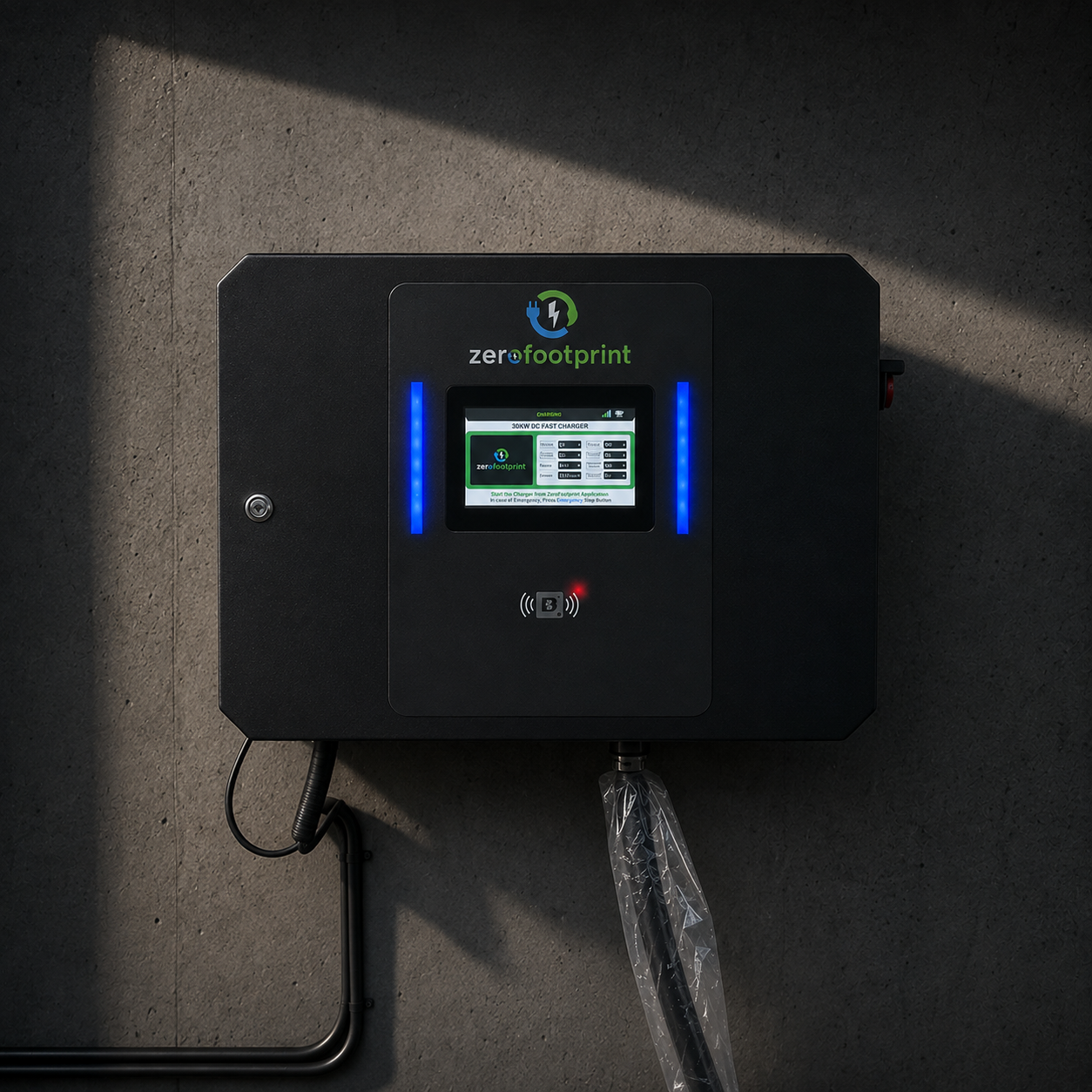
Selected variant 30 kW

Build, Display & Connectivity

03
  • 7" colour LCD, wall or pedestal mount
  • Wi-Fi / GSM / LAN, OCPP 1.6J
  • QR, Plug & Charge, app or RFID access
  • 490 x 700 x 305 mm, weighs 65 kg
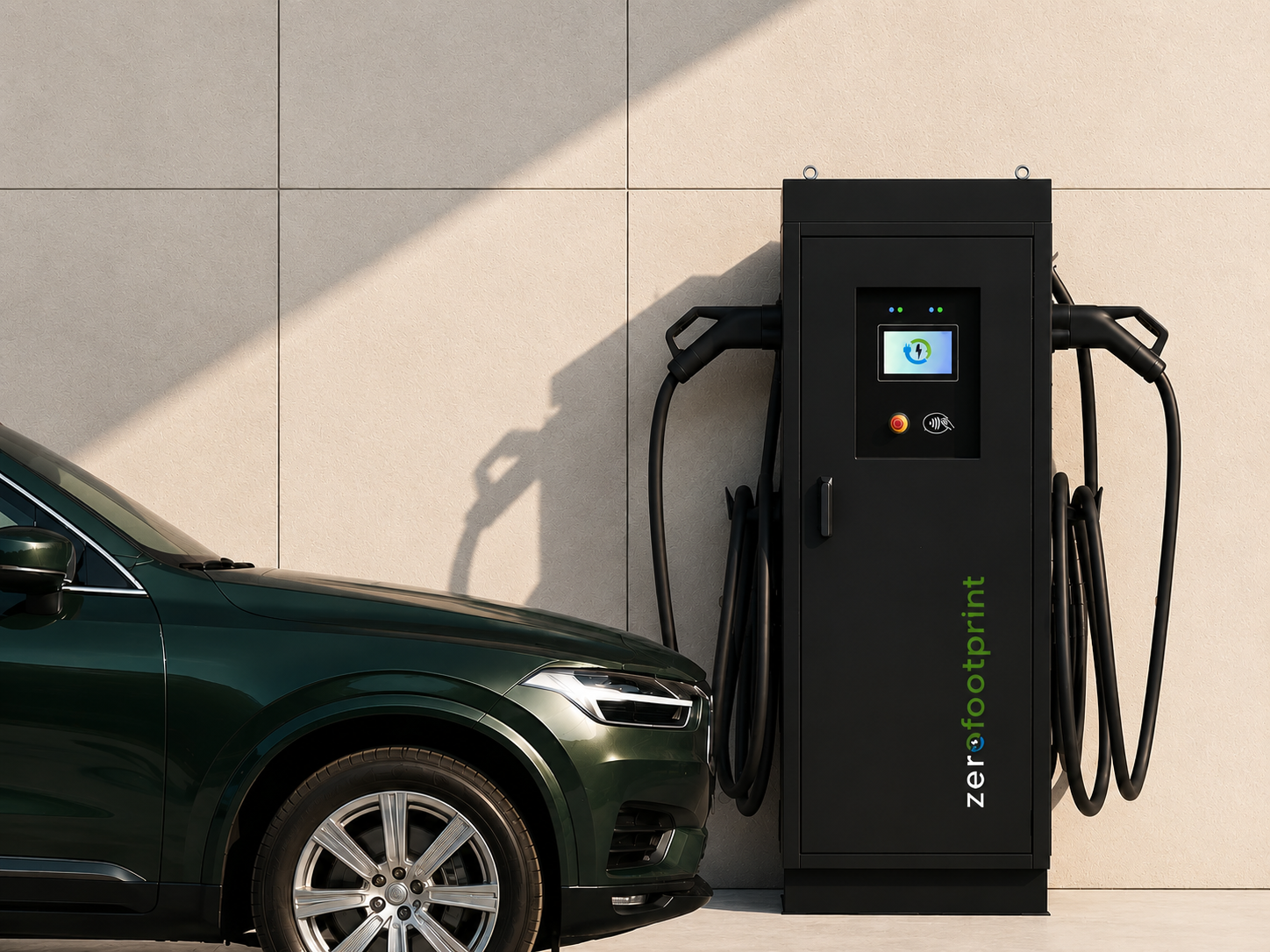
  • 15.6" touchscreen with live charging data
  • Red / green / blue LED status indicator
  • Floor-mounted, access needed on all sides
  • 1600 x 740 x 570 mm, 200 kg (±10 kg)
  • 7" colour LCD with live readouts
  • RFID, QR, Plug & Charge, app access
  • Floor-mounted, access needed on all sides
  • 1500 x 660 x 540 mm, weighs 270 kg
  • 7" colour LCD with live readouts
  • RFID, QR, Plug & Charge, app access
  • Floor-mounted, access needed on all sides
  • 1900 x 700 x 650 mm, weighs 400 kg

Site Requirements & Ratings

04
  • Input: three-phase 415V, 50Hz
  • Operating altitude up to 2000m
  • Operating temp: -40°C to +75°C
  • Wall or pedestal installation
  • 415 VAC (380–460 V), up to 120A input
  • Altitude below 2000m (derated above)
  • Operating temp: -30°C to +50°C
  • Floor-standing installation
  • 415 VAC three-phase (380–490 V)
  • Up to 250A max input current
  • Operating altitude up to 2000m
  • Indoor, or outdoor with a canopy
  • 415 VAC three-phase (380–490 V)
  • Up to 500A max input current
  • Operating altitude up to 2000m
  • Indoor, or outdoor with a canopy

Choose Your Charging Power

Pick the CCS2 DC Charger that matches your site's power availability and how fast you need vehicles moving through.

30 kWCCS2 DC Charger

60 kWCCS2 DC Charger

120 kWCCS2 DC Charger

240 kWCCS2 DC Charger

Product Highlights

Explore Your Charger Performance

Variant:

ROI Calculator

Pick a charger, tell us how busy your location is and choose your software plan — we'll instantly show your monthly earnings, net profit after power and commission, and how quickly you'll break even.

Just two quick inputs

That's all it takes

0 vehicles/day
Quiet Moderate Busy

Select a charger and enter kWh per vehicle to see this unit's daily limit.

Assumptions

₹

Software Plan — commission comes off your earnings

Net margin per kWh, after power & commission: ₹0.0

Estimated Monthly Earnings
₹0
≈ ₹0 a year in gross revenue
Net profit per charger ₹0 per month
Platform commission ₹0 Select a plan
Break-even period Add charger price on charger price

When Traffic Changes

Net profit per charger, per month, on quieter or busier days:

₹0.0k
Quiet
₹0.0k
Likely
₹0.0k
Busy

Disclaimer: These are rough estimates. Actual earnings may differ depending on the charging conditions, how busy your location is, and the condition of the vehicles and charger.

1 0 vehicles/day × 0 kWh × 30 days 0 kWh/mo
2 × your tariff ₹0/kWh = gross earnings ₹0
3 − power at ₹0/kWh − ₹0
4 − platform commission (select a plan) − ₹0
5 = net profit per charger, per month ₹0
6 net margin per kWh = ₹0 × (1 − 0%) − ₹0 ₹0.0/kWh
7 charger price not entered yet —
8 unit limit = charger kW × 24h ÷ kWh per vehicle —

Installation is not included. Install and commissioning are quoted separately after a site assessment, based on your civil, electrical and infrastructure requirements. Enterprise carries an annual software subscription in addition to the platform commission shown above. Charger price is only pre-filled for models with confirmed pricing (Portable and Hybrid chargers) — for all other models, enter the price manually to see a break-even estimate.

Frequently Asked Questions

AC chargers rely on the vehicle's onboard charger to convert power, which limits their speed. CCS2 DC chargers convert power before it reaches the vehicle, bypassing that limitation and enabling much faster charging, from 15 kW up to 240 kW depending on the unit.

The 15/30 kW units suit sites with limited power infrastructure and lower daily throughput. The 60 kW variant is built for commercial and retail locations needing a faster, dual-gun option. The 120 to 240 kW range is designed for highway corridors and fleet depots that need to move multiple high-power vehicles through quickly.

A single-gun charger serves one vehicle at a time, while a dual-gun charger can serve two vehicles simultaneously, sharing total output, or sequentially, increasing the number of vehicles a station can charge per day.

No. CCS2 DC chargers are designed for professional installation and need the right electrical infrastructure in place, including an adequate power supply, the required protection systems, proper earthing and site-specific cabling. Our team can assess your site and recommend the variant that best matches the power available at your location.

All four variants use the CCS2 standard connector, the widely adopted DC fast-charging interface for 4-wheeler and commercial EVs in India. Any EV with a CCS2 charging port can use these chargers, and the actual charging speed will depend on the maximum DC charging rate the vehicle supports.

All variants connect via Wi-Fi, GSM or LAN and communicate over OCPP 1.6J, allowing remote monitoring of charging sessions, fault status and usage data through a connected platform.

Get in Touch

Fill up the details for quick pricing estimates

CCS2 DC Chargers High-Power Charging for Every Site

Not every charging need is the same. The amount of power a site can supply, and the number of vehicles it needs to serve, should decide the charger, not the other way around. ZeroFootprint's CCS2 DC Chargers are built across a wide power band, from 15 kW compact units to 240 kW dual-gun stations, so the charger fits the site rather than forcing the site to fit the charger.

Three Variants, Three Kinds of Sites

15 kW / 30 kW

Where Power Is Limited, Speed Still Matters

A single-gun DC charger for sites where a full high-power installation isn't practical, gated communities, smaller commercial lots or fleet points with lighter throughput needs. It still delivers meaningfully faster charging than AC, without demanding a heavy-duty power connection.

60 kW

Built for the In-Between

Positioned for commercial complexes and retail hubs, this dual-gun station is sized to give a visitor a real charge in the time they're already parked, without requiring highway-grade power infrastructure.

120 to 240 kW

For When Turnaround Time Is the Business

Scalable from a 120 kW single-gun setup to a full 240 kW dual-gun station, this variant is built for highway corridors and fleet depots, sites where the number of vehicles moved through per hour is the metric that matters.

Protection That Scales With Power

Higher power output means higher stakes if something goes wrong, so protection scales with each variant. Every CCS2 charger in the range includes safeguards against over/under-voltage, over/under-current, ground faults, short-circuits, surge events and over-temperature conditions. The 60 kW unit adds an IK10 impact-resistant enclosure and forced fan cooling, while the 120 to 240 kW range carries a metal enclosure rated for outdoor use with a canopy.

One Connector Standard, Full Compatibility

Every variant uses the CCS2 connector, the standard now adopted across the majority of 4-wheeler and commercial EVs on Indian roads, so the same charging infrastructure works across a growing base of vehicles rather than locking a site into one brand or model.

Monitoring, Authentication & Remote Control

All three variants connect over Wi-Fi, GSM or LAN and communicate through OCPP 1.6J, giving operators visibility into live sessions, fault alerts and usage data from a connected platform. Authentication is flexible across the range, RFID, QR code, Plug & Charge or a mobile app, so access can be managed per site, per user, or left open for public charging.

Choosing the Right Variant for Your Site

Start with three questions: how much power your site can supply, how many vehicles you need to charge each day, and how long those vehicles typically stay parked. Where electrical supply is limited or vehicles stay parked for longer, the 15 kW / 30 kW single-gun unit gives you faster-than-AC charging without a heavy-duty connection. For commercial complexes and retail hubs where visitors stop for a shorter time, the 60 kW dual-gun station delivers a meaningful charge within that window and serves two vehicles at once. For highway corridors and fleet depots, where vehicles moved through per hour is what counts, the 120 to 240 kW range offers the fastest turnaround and can scale as demand grows. Not sure which fits? Our team can assess your site's power availability and usage pattern and recommend the right variant.